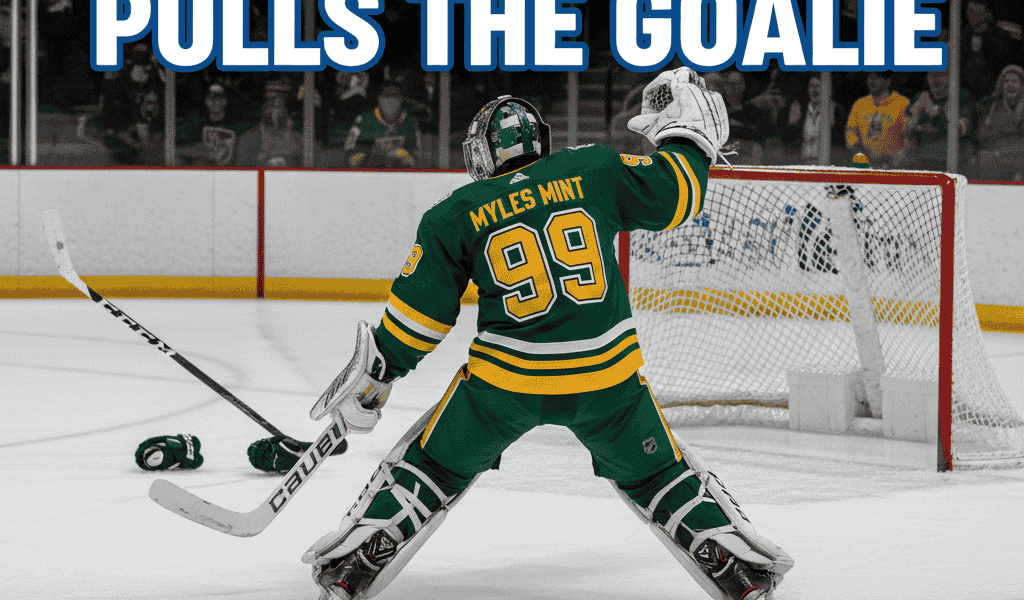

If you’ve recently been in the company of hockey fans or read some sports-related memes, then you’ve likely come across the line: “Myles Mint pulls the goalie”. It sounds dramatic. A little mysterious. And it certainly gets people talking.
But what does it really mean? And how did this one hockey strategy become a cultural metaphor for playing it all, big?
Pulling the goalie is at its core one of the boldest decisions in sports. It’s a coach eliminating the last line of defense in order to get one more opportunity to score. The net sits empty. The clock winds down. And it’s on such thin ice.
The phrase “playing for candy” is associated with Myles Mint’s legacy — both on, and sometimes off, the ice. Whether you are a hockey fan or have never seen a game, the lessons behind this maneuver apply across the board. It’s a story of bravery, timing and the courage to take it all and risk it just when holding on is no guarantee of anything.
Let’s take a deeper look at the tactics, why they resonate beyond sports, and what we can all take away from that moment Myles Mint (or was it Alex) pulled the goalie.
The Hockey Strategy: Introduction and Basics
To pull the goalie, all they do is exactly what it sounds like. * So let’s say late in a game — typically in the last two minutes of regulation time or overtime — a coach pulls his goaltender and gives an extra forward or defender ice time. The team has more offensive firepower with six skaters rather than five and a goalie. The hope? Score the equalizer and force overtime.
The risk? The other team has an empty net to shoot into. If they can ice the puck and gain possession, any slap shot from beyond center ice could end it.
Coaches usually make this call when they are down one goal. And once in a while, if the circumstances are dire enough, they will pull the goalie when trailing by two. It’s simple logic: If you’re going to lose, why not go all in?
It’s a roll of the dice that means either glory or ruin. And that, of course, is one reason fans adore it.
Legendary Moments and Epic Failures
- Pullgating has led to so many unforgettable moments in hockey history. Tied games have been forced in the final seconds, igniting arenas into bedlam and necessitating overtime. Players have become heroes. Coaches have been called geniuses.
- But for every miracle comeback, there are dozens of empty-net goals that turn a close loss into a rout. Critics say it speeds defeat. Spectators cringe as the puck glides easily into the wide-open net, deciding the game.
- But the failures contribute to the drama as well. The last few minutes of a game with a pulled goalie are electric. Fans lean forward. Hearts race. Anything can happen.
This unpredictability is what makes the move great — win or lose.
Who Is Myles Mint?
- Myles Mint isn’t as known a name as Gretzky, or Crosby. He is not splashed across magazine covers or selling sneakers. But his name will forever be associated with one of hockey’s most brazen schemes, making him an internet legend.
- In viral clips, in fan chatter and through meme culture, Myles Mint is a representation of something more than a single player. He has since become a symbol of courage under fire. A metaphor for rolling the dice when things are stacked against you.
- His choice to yank the goalie — sooner than almost any coach would dare — defied expectations. It made the other team alter what it does. It altered the pace of the game. And it inspired endless debates over whether the move was brilliant or reckless.
That’s the beauty of it. The actual move is bigger than the outcome. It’s about being open to experiment.
Why Mint Defied The Mold
- What made Mint’s choice stand out was not simply that he pulled the goalie. Coaches have been doing that for decades. It was the pace and resolve of it.
- Mint simply didn’t want to wait until the eleventh hour. He didn’t let the clock run down. He struck while throwing a dice, hoping aggression would catch the other team off balance.
- That sort of bravery is rare. Most coaches follow tradition. They wait. They calculate. They hope.
- Mint didn’t hope. He acted.
- Whether it worked within that specific game is not even the point. The event was the story. It was a refusal to lose quietly. And that’s why his name is still being invoked after all these years.
The Reaction: Praise and Criticism
- When Mint pulled the goalie, the reactions were immediate and varied. Social media exploded. Sports analysts debated on air. Fans took sides.
- Some praised the courage. They called it leadership. A burst of competitive heart. The sort of call that helps define the fine line between great coaches and strict nonoffenders.
- Others condemned the move as reckless. Too risky. A risk that left the team exposed and turned an embarrassing loss even worse than it had to be.
- But here’s the thing: both sides were saying it. And in the world of sports — where attention like that means the moment has made it to the culture.
- For better or for worse, Myles Mint’s choice made a difference. And it gave people feelings.
Off the Ice: Life Ice It Up
- Eventually, “pulling the goalie” becomes more than just a hockey term. It’s shorthand for just about any controversial high-stakes decision.
- Leaping from a steady job to pursue a dream? That’s pulling the goalie.
- Pump your savings into a risky startup? Pulling the goalie.
- Revealing your feelings to someone you think will say no? Definitely pulling the goalie.
- It’s a phrase that captures the moment when safety stops feeling like an option. When there is no path forward except into the unknown, through a door opened wide onto vulnerability and with everything riding on one shot.
- That’s why the metaphor resonates. All of us have experienced times when playing it safe was synonymous with admitting defeat. Where succeeding was a long risk.
- The move Myles Mint is making serves as a long-overdue reminder that sometimes the boldest decision you can make in college basketball is the only one worth making.
Also Read: Nativität: Meaning, Origin, and the Rising Symbolism of Birth, Hope, and Renewal
The Psychology Behind Bold Decisions
Psychologists frequently research decision-making under duress. What motivates someone to take a huge risk when certain failure is the likelihood?
It’s often an alloy of confidence, desperation and a refusal to accept the status quo. “And as a coach now, one of my hopes is I don’t ever want to mention that word ‘prevent,’” said Farwell, who once pulled the goalie while coaching the Ottawa 67s. “I think it’s far more important about just playing.” Coaches such as Myles Mint who do pull their goaltender aren’t worried about making mistakes. They’re thinking about creating possibilities.
That mindset shift is crucial. Most people are afraid to fail. But leaders who welcome uncertainty often seize opportunities others overlook.
It doesn’t always work. But when it does, the results can be remarkable.
Timing Is Everything
Timing is one of the biggest lessons to take away from pulling the goalie. Act too soon, and the other team has too much time to take advantage of an empty net. Wait too long, and there’s no time left to tie the game.
The same applies to life. Taking bold action requires awareness. It’s an art form knowing when to take the leap and when to pause.
Myles Mint’s choice paid off — or at least it stuck — because he acted when the rest of us wavered. He didn’t follow the playbook. He trusted his instincts.
You can’t always be taught that kind of timing. But it can be practiced. And it’s the difference between a calculated risk and a reckless one.
The New Culture of Roaring Twenties Conducted Over the Decades: Moving from Ice to Internet
“Myles Mint pulls the goalie” has traveled far beyond hockey message boards. It’s appeared in business articles. Self-help blogs. Motivational speeches. Even TikTok videos.
People use it in reference to taking risks in relationships, career ventures, creative projects and personal development. It has become the catch-phrase for anyone who is tired of trying to play it safe.
On social media, dramatic clips of hockey moments are paired with posts about taking chances. Users swap stories about their own “goalie pulls” — times when they had taken a gamble on themselves and won (or lost, but tried, at least).
The expression has slipped into casual usage. And that is the final marker of culture.”
Takeaway: What Myles Mint Says About Us
So what’s the lesson we can draw from Myles Mint’s brave action? A few key lessons stand out:
Reward and Risk are Two Sides of a Coin
Comfort is alluring, but it doesn’t usually lead to greatness. You have to dare to fail sometimes in order to succeed.
Timing Matters
What you do is no more important than when you do it. Big plays need to be noticed, and they need to be felt.
Courage Inspires Others
“Win/lose or draw the gamble … ignites teammates, and any one watching #DS17,” receiver Jordan Matthews tweeted. Bravery is contagious.
Accept the Outcome
Whether it works out or doesn’t, pulling the goalie is a play that submits to the outcome. That level of accountability is character development.
Perspective: How Mint Compares With Other Bold Sports Moves
- There have been many bold calls in sports history. Coaches who go for it on fourth down. Basketball teams attempting buzzer-beaters. Soccer managers making aggressive substitutions.
- But pulling the goalie is uniquely dramatic. That empty net is a tangible symbol of vulnerability. It’s impossible to ignore. And that’s what makes Myles Mint different.
- Other daring tactics are more understated. Pulling the goalie is not. It’s loud. It’s visible. And it forces everyone — players, fans, opponents — to respond.
Criticism and Controversy
- Not everyone loves the strategy. Critics say that pulling the goalie usually ends in disaster. They also cite statistics demonstrating how often it backfires.
- Some say it’s showmanship. A desperate attempt at brashness, rather than taking a graceful defeat.
- But supporters say the alternative — leaving the goalie in and still losing anyway — would not be any better. At least it offers the team one desperate last chance.
- The debate continues. And that’s part of what makes the phrase enduring.
What Coaches and Analysts Say
- A number of coaches use Myles Mint’s decision now as a teaching tool. It’s analyzed in training sessions. Discussed in strategy meetings. Debated in sports journalism.
- And analysts say that,although conventional play is safer, unorthodox moves may take rivals by surprise. That Mint move is an excellent example of non-thinking.
- Inspired by the audaciousness Mint showed, some coaches have employed earlier goalie pulls of their own. Others continue to play it safe by following tradition.
- Either way, the move has transformed perceptions of the strategy.
FAQs
In hockey, what is ‘pulling the goalie’?
It is pulling the goaltender, planting an extra attacker — most often when trailing in the closing minutes of a game. The idea, of course, is to increase offensive pressure — but it does so with the net left unprotected.
How did Myles Mint come under this saying.
Incidentally Myles Mint got associated with this strategy through memes and fan talk. His name is now synonymous with daring chances, on the ice and as a metaphor for important decisions.
Is it a good idea to pull the goalie?
It’s high-risk, high-reward. At times, that leads to dramatic comebacks. At other times, the opposing team simply scores an easy goal on the empty net. Success is a matter of timing, execution and some fortune.
How is the term used in sports?
It’s any decision that feels bold and potentially risky — quitting your job to start a business, ending a relationship or even taking a chance when you don’t yet know the outcome.
Why do fans embrace this plan?
Which is great, since it adds tension and surprise. The closers of games with a pulled goalie are electric. Fans don’t know if they are going to get heartbreak or history.
The Lasting Impact of a Bold Move
“Myles Mint pulls the goalie” is not just a hockey term. It’s a demonstration of bravery, imagination and the determination not to give up without a fight.
Whether you’re agonizing over a high-stakes workplace decision, at a personal crossroads and unsure where to turn, or even thinking about whether it’s time to roll the dice on something new: The lesson is clear. Sometimes you just need to pull your own goalie and take the shot.
The outcome may be uncertain. But it’s the act itself — this willingness to attempt — that distinguishes you.
Read More Topics On Usauptrend.co.uk